Developers
Build on AnswerStack. Give nothing more access than it needs.
A REST API described in OpenAPI, an MCP server for AI assistants and agents, a signed webhook, and tokens scoped to exactly what each script, partner or app should do.
Three ways in
REST API
Calls, transcripts, insights, bookings, callbacks, playbooks and knowledge over HTTPS and JSON, in an OpenAPI document that marks every route a token may use.
MCP server
22 tools and 4 resources for AI assistants and agents, with sign-in and consent through our own OAuth server.
Webhook
Contacts, call logs and follow-up tasks pushed to your endpoint as they happen, signed.
API tokens
A token for every job, and only for that job.
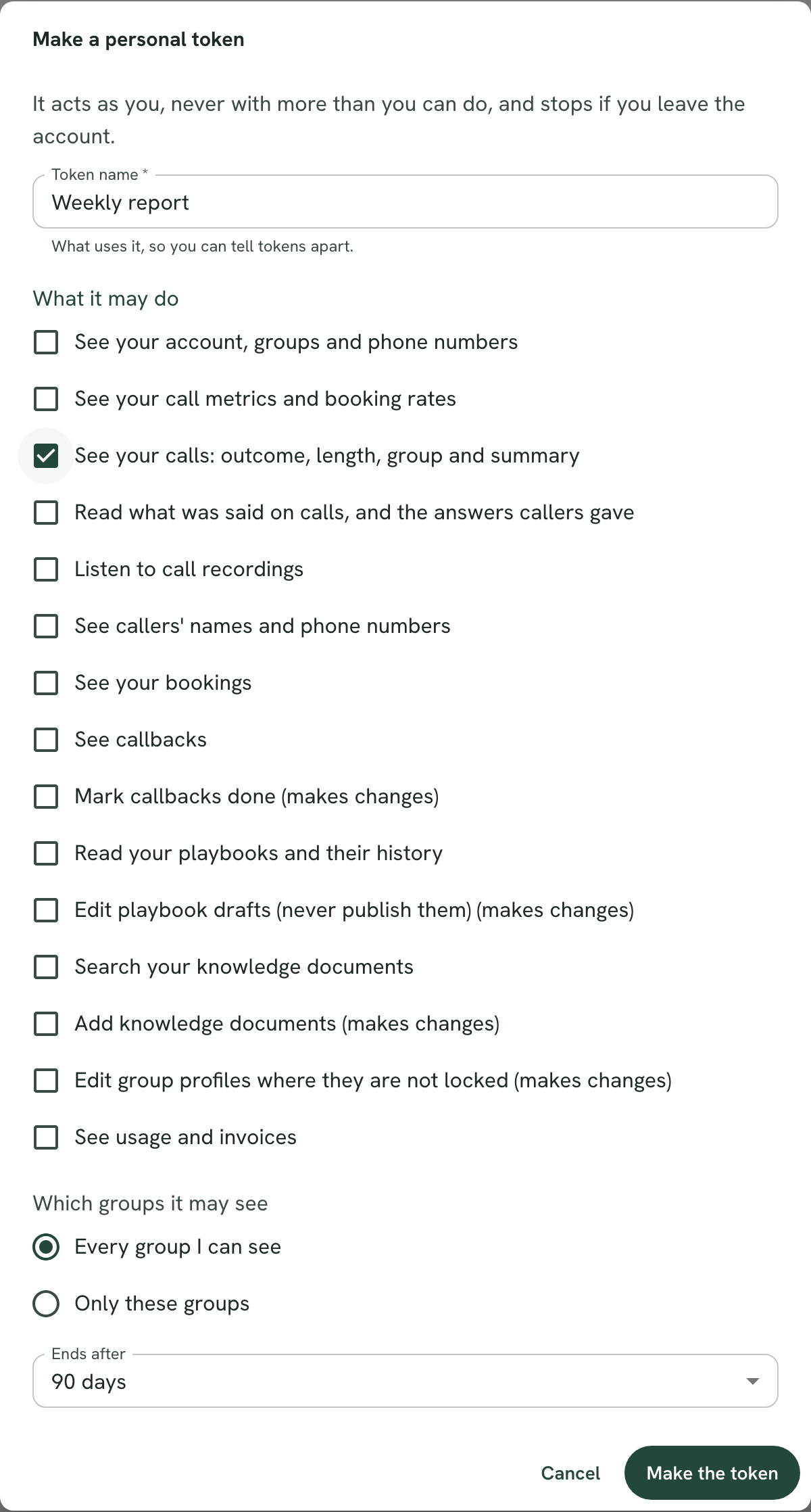
Each token carries scopes in plain words, the same permissions an AI assistant asks for, so there is one model to learn.
Personal tokens
For your own scripts. Acts as you, never with more than your role allows, and ends after 30, 90 or 365 days, or when you leave.
Service identities
For software, not people: a data warehouse, a partner’s system. A role ceiling, optional community limits, and IP allowlists.
Machine OAuth
For partners that expect OAuth: client credentials for short-lived tokens to the MCP server.
curl "$ANSWERSTACK_API/v1/account/calls?outcome=booked&limit=50" \
-H "Authorization: Bearer $ANSWERSTACK_TOKEN"- Warehouse loader
ans_svc_…7Q2K - Nightly export
ans_pat_…OVyA
MCP server
Your account, inside the AI tools your team already uses.
Add one address to any MCP client. The member signs in and chooses what it may do; the client can then ask about calls, trends, visits and open callbacks in plain language.
{
  "mcpServers": {
    "answerstack": { "url": "https://api.example.com/mcp" }
  }
}
Your account’s address comes with your early access setup.
- Ask for the least you need. A refused call names the scope to ask for.
- What callers said comes back marked as untrusted text, so your agent never takes it as an instruction.
- 60 requests a minute per token or connected app, and 10 changes a minute per app.
Account
list_groupsget_usageCalls
search_callsget_callget_transcriptget_analyticsInsights
get_scorecardcompare_insightsquery_insightsBookings, visits and callbacks
list_bookingsget_visitlist_visit_actionslist_callbackscomplete_callbackPlaybooks
list_playbooksget_playbook_versiondiff_playbook_versionsupdate_playbook_draftsimulate_booking_rulesKnowledge and communities
search_knowledgeadd_knowledge_documentupdate_group_profile
Scopes, in plain words
The same list a member sees on the consent screen and when making a token. Scopes that make changes are marked.
| Scope | What it allows | Makes changes |
|---|---|---|
account:read | See your account, groups and phone numbers | No |
analytics:read | See your call metrics and booking rates | No |
insights:read | See Insights: scorecards, comparisons and trends, peers kept anonymous | No |
calls:read | See your calls: outcome, length, group and summary | No |
transcripts:read | Read what was said on calls, and the answers callers gave | No |
recordings:read | Listen to call recordings | No |
contacts:read | See callers' names and phone numbers | No |
bookings:read | See your bookings | No |
callbacks:read | See callbacks | No |
callbacks:write | Mark callbacks done | Yes |
playbooks:read | Read your playbooks and their history | No |
playbooks:write | Edit playbook drafts (never publish them) | Yes |
knowledge:read | Search your knowledge documents | No |
knowledge:write | Add knowledge documents | Yes |
groups:write | Edit and publish group profiles where they are not locked | Yes |
usage:read | See usage and invoices | No |
Security model
Built so a leaked token is a small problem.
Shown once, stored as a hash
We keep only a fingerprint. Prefixes (ans_pat_, ans_svc_) make a leaked one easy to spot.
Scoped and narrowed
Never more than its scopes, its owner’s role today, or the communities it was limited to.
Revoked at once
Revoke a token or an app and it stops. Deactivating a member ends their tokens with them.
Audited
Every change a token or app makes is logged, and each owner is emailed a week before a token ends.
Hear it answer for your community
Early access partners get a sample community set up with their own name and tour hours, a call from their own phone, and pilot pricing shaped around the parts they choose.